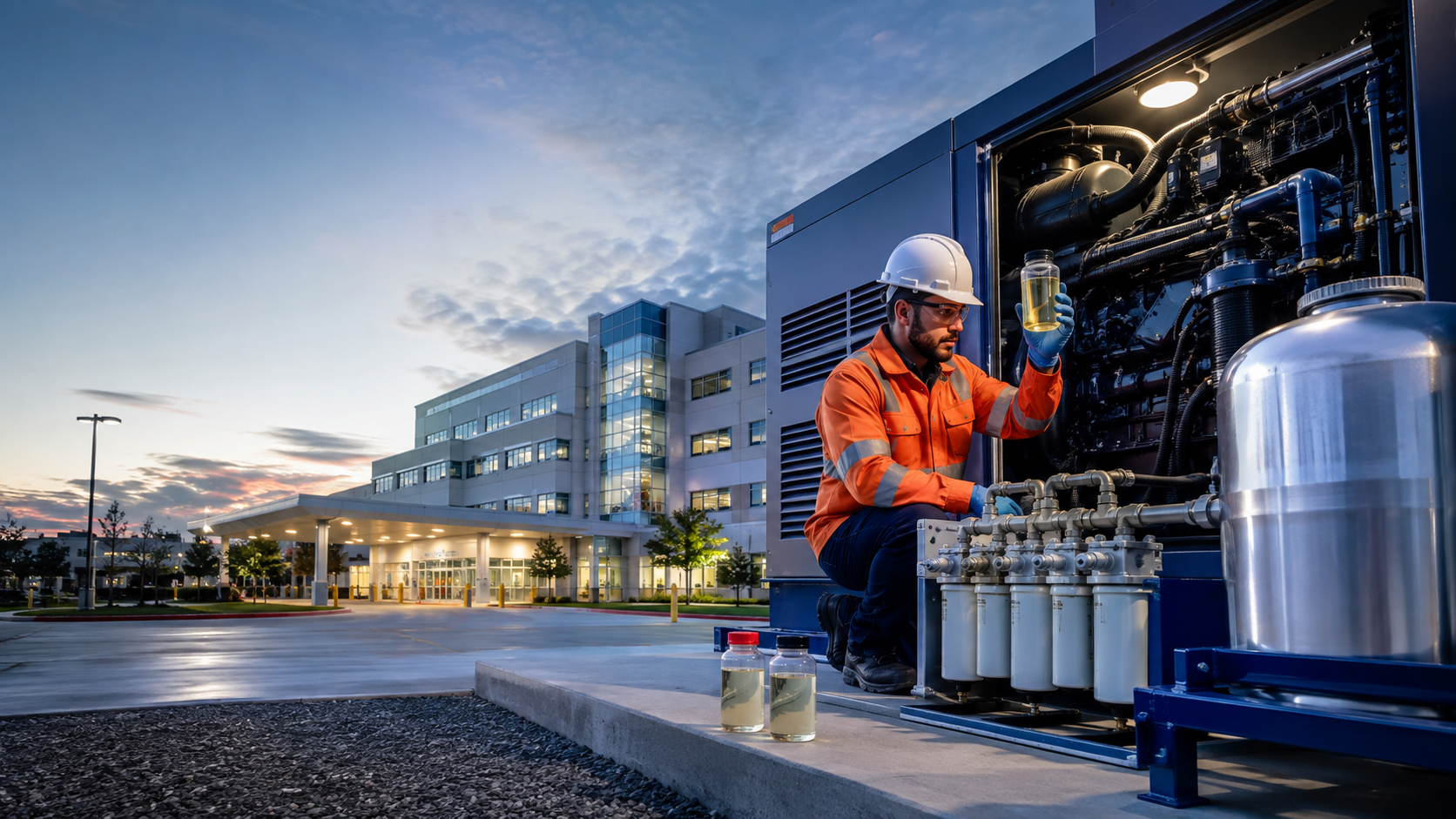
NFPA 110 Fuel Requirements: What Hospitals Must Know
A plain-English guide to fuel quality, inspection routines, testing, documentation, and the maintenance practices that help hospital emergency power systems perform when normal power fails.
In a hospital, emergency power is not a convenience. It supports life-safety systems, critical care areas, medication storage, communications, elevators, fire protection, and the equipment clinicians rely on during an outage. NFPA 110 provides the framework for emergency and standby power systems, but compliance is more than a generator that starts during a scheduled test.
The fuel supply is part of the emergency power system. If fuel is wet, unstable, contaminated, or unable to move through the filters, the generator can lose power when the hospital needs it most. This guide breaks down the practical fuel responsibilities facility teams should understand and document.
Important: NFPA 110 requirements work alongside local fire codes, state rules, accreditation standards, manufacturer instructions, and the hospital’s emergency power plan. Use this article as a maintenance guide, not as a substitute for the edition adopted by your authority having jurisdiction.
Four Fuel Responsibilities Hospitals Cannot Ignore
A dependable emergency power program connects fuel condition, equipment testing, maintenance, and records. Leaving out any one of these areas creates a blind spot.
Fuel quality
Emergency power supply system fuel must remain clean, stable, and suitable for the generator. Water, sediment, microbial growth, and oxidation byproducts can restrict fuel flow and damage injection components.
Routine inspections
Hospitals need a repeatable inspection program that checks fuel levels, tank condition, piping, filters, day tanks, and the general readiness of the emergency power supply system.
Fuel testing
Visual checks are useful, but they cannot identify every fuel problem. Laboratory testing provides a clearer picture of water, sediment, stability, microbial contamination, and whether treatment is needed.
Written records
Testing, maintenance, load tests, corrective actions, and service dates should be documented so the facility can demonstrate an active compliance program during an inspection or accreditation review.
A Practical Inspection Schedule
The exact schedule should match your adopted code, equipment manuals, and facility risk plan. This rhythm gives hospital teams a clear starting point for keeping fuel readiness visible.
Visual readiness check
- Confirm the fuel level is sufficient for the facility’s emergency runtime plan.
- Inspect the day tank, piping, valves, and containment area for leaks or damage.
- Look for water, haze, sediment, unusual color, or other visible changes in accessible samples.
Operational test and review
- Run the generator under load according to the facility’s testing program.
- Record fuel pressure, exhaust condition, runtime, alarms, and any abnormal behavior.
- Check filters, separators, vents, and automatic fuel transfer equipment.
Fuel quality program review
- Complete a documented fuel quality test and compare results with the laboratory report and equipment requirements.
- Review polishing, water removal, biocide, and filter replacement history.
- Update emergency contacts, corrective action procedures, and the service plan before hurricane season.
What a Fuel Sample Reveals
A representative sample can reveal water at the tank bottom, sediment, microbial activity, color changes, fuel degradation, and signs that a filter or tank needs attention.
Sample the lowest practical point and include the day tank when the system design allows it. A clean bulk tank does not automatically mean the fuel is clean at the engine.
When Fuel Needs Treatment
Water removal, fuel polishing, biocide treatment, and filter replacement each address a different problem. The treatment should follow the sample results and equipment condition.
After treatment, sample again and document the result. The goal is not just to make fuel look better; it is to restore a dependable supply and verify that the problem is under control.
Common Compliance Gaps
These habits can leave a hospital with a generator that appears maintained but lacks proof of fuel readiness:
- Treating a full tank as proof that the fuel is usable.
- Testing only after a generator fails or an inspector requests a sample.
- Testing the bulk tank but not the generator day tank or transfer system.
- Replacing a clogged filter without finding the contamination source.
- Keeping service invoices but not a clear, dated fuel testing log.
Make Fuel Readiness Measurable
Gulf Coast Fuel Polishing helps hospitals build a documented fuel maintenance program with sampling, testing, polishing, filter service, and clear records for the next inspection.